
Modpool vs Ecopool Container Pools
Two brands, two approaches — here's what separates them

Both companies build container-based pools, and on the surface the products can look similar. But the engineering, materials, and long-term ownership experience are meaningfully different — and if you're spending $40,000–$80,000+ on a pool, those differences matter.
This comparison breaks down where Modpool and Ecopool diverge — from wall construction and interior materials to modularity, insulation, and logistics — so you can make an informed decision.
Whether you're looking at a compact plunge pool, a backyard lap pool, or a full-size container swimming pool, here's what you should know.
What Modpool Buyers Tend to Discover Late
We regularly hear from homeowners who've researched both brands. These are the most common concerns that come up about Modpool:
1. Corrugated walls are a cleaning headache
The ridges look fine in photos. In practice, algae settles into the valleys where your brush and your robot can't reach properly. You end up hand-scrubbing grooves that a smooth-wall pool wouldn't have.
2. Width is locked to a single container
Modpool's maximum width is 11'8" — the width of a shipping container. There's no bolt-together system to go wider. If you want a 16-foot-wide pool, it's not an option.
3. Oversized freight from Canada
That 11'8" width exceeds standard legal transport limits in most U.S. states. You're looking at oversize permits, escort vehicles, and route planning — costs that add up fast, especially the further south you are.
4. Spray-on interior coating has limits
Modpool uses a polyurea spray coating. It's a capable industrial product, but spray-on application is only as good as the technician that day. Pinholes, uneven coverage, and adhesion issues are known risks with field-applied coatings. Superchlorination (shock treatments) can also accelerate degradation on certain spray coatings over time.
5. Limited color and finish options
If you want something beyond solid blue, grey, or black — you're largely out of luck. There's no tile-look, no stone texture, no 3D embossed finish.
6. The skimmer sits inside the pool
Modpool's skimmer is exposed inside the swimming area. It works, but it's visible, it takes up wall space, and it's one more thing for kids to bump into.
7. No insulated wall system
A standard shipping container is a steel box. There's no integrated thermal envelope, which means your heater works harder to maintain temperature — particularly in spring, fall, and overnight.
"None of these are necessarily dealbreakers on their own — but together, they represent a meaningful gap in engineering and long-term ownership experience."
Modpool vs Ecopool: At-a-Glance
| Modpool | Ecopool | |
|---|---|---|
| Size | Limited | Unlimited. Patented modules connect for unlimited sizes. |
| Interior Wall | Corrugated & hard to clean | Smooth & easy to clean |
| Interior Surface Material | Polyurea spray-on coating | Zycore Commercial Grade German-Engineered Pool Membrane |
| Exterior Color | Black only | Custom colors |
| Interior Color | Solid blue or grey | Many designs |
| Interior Tile Design | Not available | Available |
| Oversized Shipment | 11' 8" width is oversized | Never oversized due to modules |
| Made In | Canada | Salado, Texas, USA |
Size, Modularity, and the Width Problem
There's a difference between a modular product and a modular building system — and it matters.
Modpool ships a finished single-piece container. The pool you get is the pool they built. Width maxes out at 11'8", and you can't combine units to go larger.
We designed Ecopool from the start as a true modular building system. Our factory-built sections ship within standard freight widths, then bolt together on-site into a single unified pool. Want 16 feet wide? Done. Need a longer lap pool? Add another section. Your pool size isn't dictated by what fits on one truck.

That distinction has real consequences. A family that wants a 12×32 pool with a bench and a tanning ledge can get exactly that from us. With Modpool, you choose from predefined sizes and hope one works for your yard.


"If 'modular' just means the pool arrives in one piece on a truck, that's delivery — not modularity."
Corrugated vs. Smooth Walls — and Why It's Not Just Aesthetic
This is one of the first things people notice when comparing the two pools, and for good reason.
Modpool keeps the corrugated steel interior from the original container design. It's become part of their visual identity — the industrial look.

Here's the problem: corrugation creates grooves. Grooves collect debris. Algae anchors in the valleys where your pool brush glides right over. Robotic cleaners — Dolphin, Polaris, whatever brand — are designed for flat surfaces. They lose suction contact on ridges and skip the low points. You end up hand-scrubbing areas that shouldn't need it.
Our interiors are flat and smooth. No ridges, no valleys, no hidden spots for algae to collect.
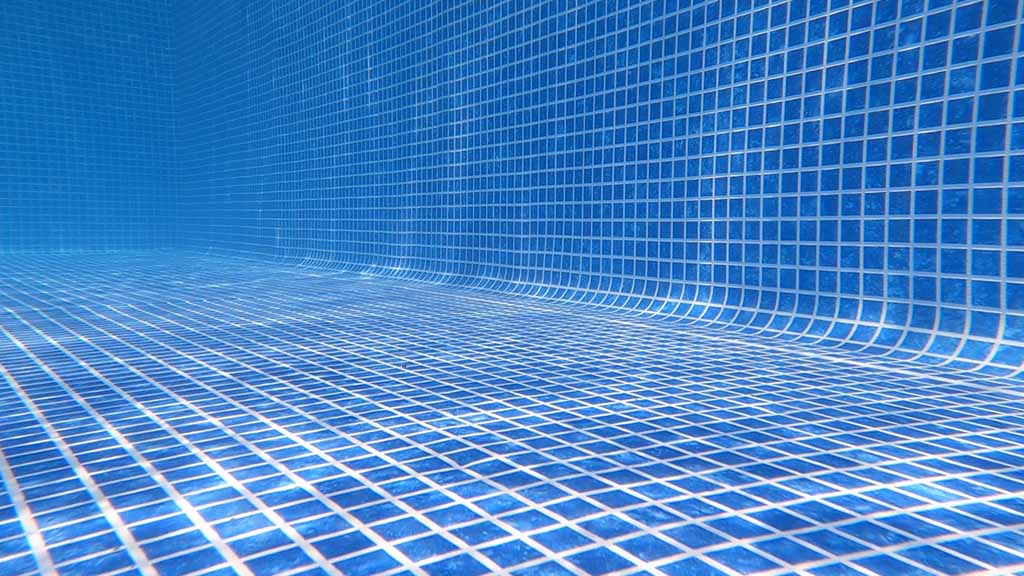
If you own a robotic cleaner (and you should — they're one of the best investments in pool ownership), smooth walls are the difference between "set it and forget it" and "go back and hand-brush the spots it missed."
"Smooth walls aren't just an aesthetic choice — they simplify weekly maintenance and give robotic cleaners full surface contact."
Interior Finish: Spray Coating vs. Zycore™ Membrane
This is where the engineering gap gets serious.
What Modpool uses
Modpool applies a polyurea spray coating to the interior. Polyurea is used across many industries — truck bed liners, bridge decks, industrial containment. It's a legitimate material. But the quality of a spray-on coating depends entirely on application: surface prep, ambient conditions, spray technique, and cure time. Pinholes and thin spots happen. You can't inspect what you can't see, and once the pool is filled, you're trusting that every square inch was covered perfectly.
High chlorine events — shock treatments, algae kills, seasonal startups — also stress spray coatings over time. This isn't unique to Modpool; it's a known consideration with any spray-applied pool finish.
What we use
We use Zycore™ — a reinforced, German-engineered architectural membrane that's heat-welded in our factory, not sprayed in the field. It's a multilayer polymer system with a fiber-reinforced core: non-porous, UV-stable, chemically inert, and engineered to flex with the structure rather than crack against it.
This is the same class of technology used in European competition pools, municipal facilities, and high-profile U.S. venues. It's not new or experimental — it's been the commercial standard in Western Europe for decades.

Zycore™ can last 25–30 years with proper water chemistry. It doesn't need resurfacing, doesn't develop pinholes from application variability, and doesn't degrade under normal chlorine exposure.
Zycore™ also enables 3D embossed textures that look and feel like stone, tile, or natural materials — something Modpool's spray coating doesn't support. These aren't printed patterns; they're precision-embossed into the membrane itself.
"Factory-welded membrane vs. field-sprayed coating. One removes human variability from the equation. The other depends on it."
Skimmer Design: Exposed vs. Integrated
A small detail that matters more than you'd think.
Modpool's skimmer sits inside the pool, visually exposed and physically protruding into the swim area. It functions fine, but it's one more thing occupying wall space — and one more hard edge in a pool where kids are playing.

We use external or structurally integrated skimmers that blend into the pool's design. Less visual clutter, fewer impact points, cleaner interior lines.

If you're building a plunge pool where every square foot of swim space matters, exposed hardware inside the pool is a real compromise.
Insulation and Energy Costs
A shipping container is a steel box. It has zero built-in insulation. Without modification, it bleeds heat in cool weather and absorbs ambient heat in the summer.
Modpool doesn't advertise an insulated wall system. That means your heater is fighting thermal loss through bare steel — especially overnight and during shoulder seasons (March, April, October, November) when you most want to extend your swim season.
Our container models use insulated panel construction. The S-Series takes this further with a continuous insulated envelope reaching R-8.5 to R-10. For context, a typical concrete pool sits at roughly R-1.5.
What does that mean in practice? Fewer heater cycles, lower electric and gas bills, and water that still feels comfortable when you step in on a cool April morning instead of gasping. Over 10–15 years of ownership, the energy savings alone are meaningful — especially if you heat year-round or live in a climate with real winters.
"Insulation is the difference between a seasonal pool and a year-round one — and it shows up on every energy bill."
Installation Flexibility: Where Can It Go?
Our pools install inground, above ground, or semi-inground. That flexibility matters more than most buyers realize during the planning phase.
Rocky site? Go above ground and skip excavation entirely — often a five-figure savings in hard-rock markets across Texas, the Southeast, and mountain regions. Sloped yard? Semi-inground rides the grade elegantly. Want a flush patio edge? Full inground.
Modpool is primarily designed for above-ground or partially recessed placement. Full in-ground installation adds complexity since the unit was originally engineered as a freestanding container.
The ability to choose your installation method based on your site conditions — rather than being locked into one approach — is a significant practical advantage.
Color and Design Options
Modpool exteriors are primarily black. Interiors are limited to a handful of solid colors — blue, grey, and a few variations. That's it.
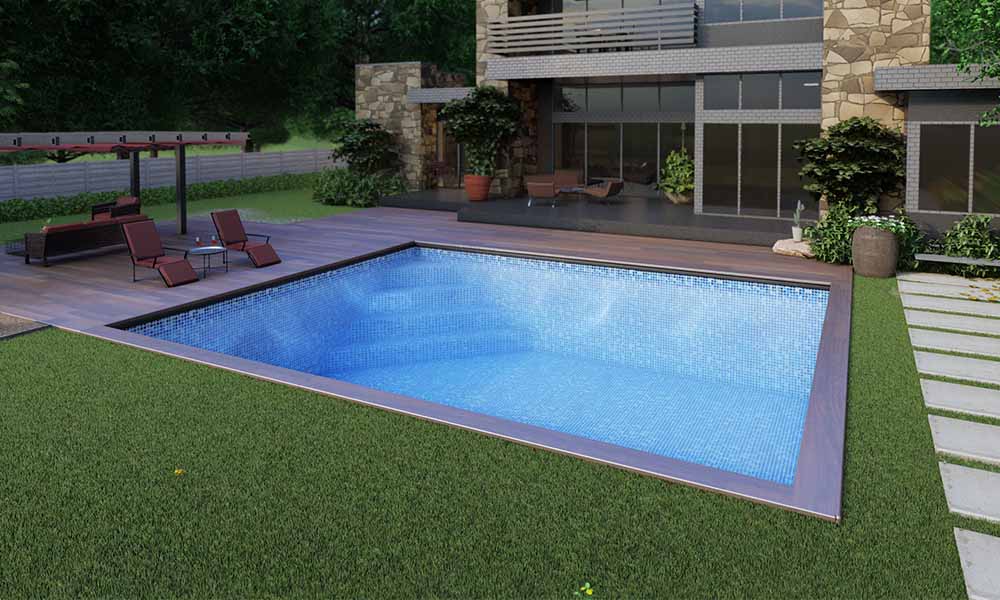
We offer customizable exterior finishes and a significantly broader interior palette: designer colors, tile-look textures, stone-inspired 3D embossed surfaces, and multiple finish styles.

If you're trying to match pool aesthetics to your home's architecture and landscaping — modern farmhouse, mid-century, Mediterranean, contemporary — color and texture flexibility is the difference between a pool that blends in and one that sticks out.
Shipping and Logistics
Modpool ships from Canada. Their 11'8" width exceeds standard legal freight dimensions in most U.S. states (8'6" is the cutoff for standard loads). That means oversized permits, pilot cars, restricted route planning, and higher freight costs — all before the pool arrives at your curb.
The further you are from the Canadian border, the more this adds up. A Modpool delivery to Texas, Florida, or Arizona carries a substantially larger freight bill than a domestic shipment.
We ship from Texas. Our modules are engineered to fit within standard legal freight widths. No oversized permits. No escort vehicles. Standard carriers, standard routes, lower cost.
Freight can swing your total project budget by thousands of dollars. We recommend requesting a delivered price from any pool company — not just the base pool price — so you're comparing total costs.
Manufacturing and Warranty
We design and manufacture every Ecopool in Texas. Factory production means controlled conditions for membrane welding, quality inspection at every stage, and no weather dependencies in the build process.
Modpool is manufactured in Canada. For U.S. buyers, that means international shipping timelines, potential customs considerations, and warranty service that originates from a different country.
When evaluating any pool purchase, we'd encourage you to request full warranty documentation from every brand you're considering — what's covered, what's excluded, how long, and what the claims process looks like. We're happy to share ours anytime.
Beyond Containers: The Ecopool S-Series
If you started your search looking at container pools but find yourself wanting more flexibility, our lineup doesn't stop at containers.
The S-Series is a fully modular steel pool system that's no longer constrained by container dimensions at all. High-strength tubular steel frames bolt together on-site to create virtually any configuration: custom widths, lengths, depths, benches, tanning ledges, spa sections, L-shapes, even U-shapes.
Think of it this way: the container pool is the entry point. The S-Series is what happens when you take the same factory-built, insulated, membrane-lined approach and remove the dimensional limits entirely.
The S-Series uses the same Zycore™ interior, the same insulated wall construction (R-8.5 to R-10), and the same factory QC — just in a format that gives you architectural freedom that no container pool can match.
Modpool does not offer an equivalent system. If you outgrow the container format with Modpool, you'd need to look at a completely different pool type from a different company. With us, it's a natural step up within the same product family.

"The S-Series gives you architectural freedom beyond container dimensions — with the same factory precision, insulation, and Zycore™ interior."
The Bottom Line
Here's what it comes down to:
- Walls: Our interiors are smooth. Modpool's are corrugated. That difference shows up every time you clean.
- Interior: We use Zycore™ — a heat-welded, factory-controlled membrane rated for 25–30 years. Modpool uses a field-sprayed polyurea coating.
- Size: Our modules bolt together for the width and length you need. Modpool ships a fixed container.
- Insulation: Our insulated walls reduce energy costs and extend your swim season. Modpool does not advertise an insulated wall system.
- Shipping: We ship standard freight from Texas. Modpool ships oversized from Canada.
- Design: We offer 3D textures, tile finishes, and custom exterior and interior colors. Modpool's options are limited to a few solid colors.
- Growth path: If you want more than a container someday, our S-Series removes dimensional limits entirely. Modpool does not offer an equivalent system.
Both companies make container pools. The differences are in how they're built, what they're built with, and how they perform over years of ownership.
"Ready to see the difference for yourself? Contact us and we'll help you figure out the right pool for your backyard."

